
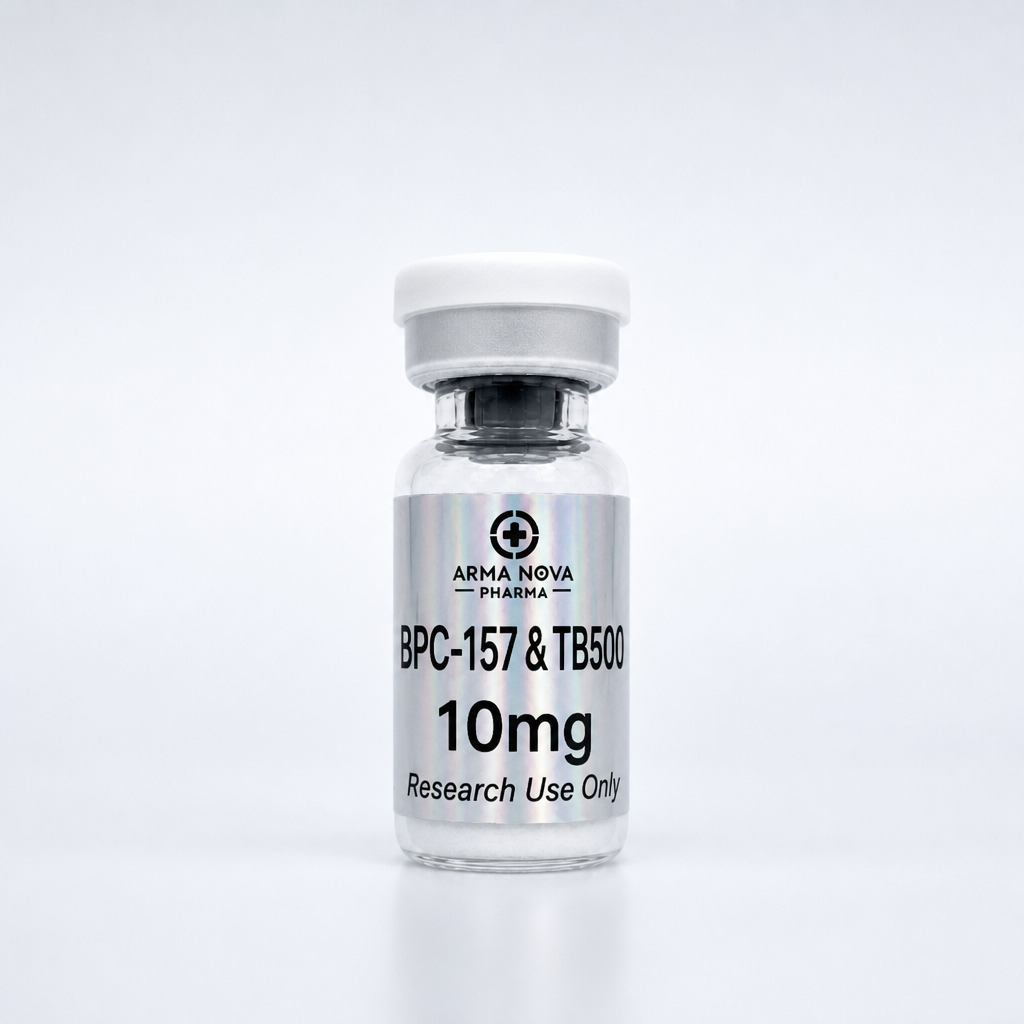
BPC-157 & TB500 BLEND 10MG
£34.00
BPC-157 TB500 Blend 10mg — lyophilised dual-peptide research compound, ≥99% purity, supplied as a white powder in a sealed vial. Contains 5mg BPC-157 (stable gastric pentadecapeptide) and 5mg TB-500 (Thymosin Beta-4 fragment), formulated for combined tissue repair and cytoskeletal remodelling research. Certificate of Analysis available. For research use only.
16 people are viewing this product right now
🔥 11 items sold in last 3 hours
What Is BPC-157 TB500 Blend 10mg?
BPC-157 TB500 Blend 10mg is a lyophilised dual-peptide research compound containing 5mg of BPC-157 and 5mg of TB-500 in a single sealed vial. BPC-157 is a stable synthetic pentadecapeptide (15 amino acids) derived from a naturally occurring gastric protein with a molecular weight of 1,419.5 g/mol and molecular formula C₆₂H₉₈N₁₆O₂₂ (PubChem CID 9941957). TB-500 is a synthetic fragment of Thymosin Beta-4, a 43-amino acid protein involved in actin regulation and cytoskeletal organisation, with a molecular formula of C₂₁₂H₃₅₀N₅₆O₇₈S and molecular weight of approximately 4,963 g/mol. Together in the BPC-157 TB500 Blend 10mg, these two peptides are used in preclinical research to study complementary mechanisms of tissue repair and regeneration. All batches are verified at ≥99% purity by independent HPLC and mass spectrometry — results available on our Certificate of Analysis page. For research use only.
BPC-157: Mechanism of Action
BPC-157 promotes tissue repair through multiple overlapping pathways. Research demonstrates that it upregulates growth hormone receptor expression in tendon fibroblasts, facilitates angiogenesis via VEGFR2 signalling, stimulates collagen synthesis, and modulates nitric oxide production. It has been studied extensively in in vivo models across tendon, ligament, muscle, bone, and gastrointestinal tissue injury. A detailed review of BPC-157’s wound healing mechanisms is published in PMC8275860 (Stable Gastric Pentadecapeptide BPC 157 and Wound Healing).
TB-500: Mechanism of Action
TB-500 acts primarily through actin sequestration — binding G-actin to regulate cytoskeletal dynamics, which drives cell migration, proliferation, and differentiation. It also downregulates inflammatory mediators and has been associated with cardioprotective effects in animal models. As a Thymosin Beta-4 fragment, TB-500 retains the key actin-binding domain (LKKTET sequence) responsible for its biological activity in tissue remodelling research. Foundational research on thymosin beta-4 and tissue repair is documented in PubMed (PMID 30915550).
Why Use a Blend?
BPC-157 and TB-500 operate via distinct but complementary mechanisms — BPC-157 primarily through growth factor receptor upregulation and angiogenesis, TB-500 through actin-mediated cell migration and cytoskeletal remodelling. In preclinical models, their combined use in the BPC-157 TB500 Blend 10mg allows researchers to study potential synergistic effects on tissue repair across multiple signalling axes simultaneously, reducing experimental complexity compared to running two separate compounds.
Research Areas
The BPC-157 TB500 Blend 10mg is used across the following preclinical research disciplines:
- Tendon and ligament repair — collagen remodelling, fibroblast proliferation, and mechanical tensile strength recovery models
- Muscle tissue regeneration — satellite cell activation, myofibre repair, and inflammatory resolution assays
- Angiogenesis research — VEGFR2-mediated neovascularisation and capillary sprouting models
- Gastrointestinal repair — mucosal healing, gut barrier integrity, and fistula closure studies (BPC-157 component)
- Cytoskeletal biology — actin dynamics, cell motility, and wound closure assays (TB-500 component)
Supplied Format & Specification
| Parameter | BPC-157 | TB-500 |
|---|---|---|
| Amount per vial | 5mg | 5mg |
| Total vial content | 10mg blend | |
| Form | Lyophilised powder | |
| Appearance | White to off-white powder | |
| Purity | ≥99% (HPLC verified) | |
| Molecular Formula | C₆₂H₉₈N₁₆O₂₂ | C₂₁₂H₃₅₀N₅₆O₇₈S |
| Molecular Weight | 1,419.5 g/mol | ~4,963 g/mol |
| CAS Number | 137525-51-0 | 77591-33-4 |
| Storage | −20°C, away from moisture and light | |
| Usage | Research use only | |
Purity & Quality Assurance
Every batch of BPC-157 TB500 Blend 10mg supplied by Arma Peptides is independently tested before dispatch. Both peptide components are confirmed at ≥99% purity by HPLC with identity verified by mass spectrometry. Batch-specific CoA documentation is available on our laboratory tests page.
Storage Conditions
Store lyophilised BPC-157 TB500 Blend 10mg at −20°C in a dry, dark environment. Avoid freeze-thaw cycles to preserve both peptide components. Once reconstituted for in vitro use, aliquot immediately and store at −80°C.
Related Research Peptides
Researchers working with BPC-157 TB500 Blend 10mg often also use the individual components or higher-dose formats. Browse related peptides from Arma Peptides:
- BPC-157 10mg — standalone BPC-157 for single-compound tissue repair studies
- BPC-157 & TB500 Blend 20mg — higher-dose blend for extended in vitro protocols
- TB500 5mg — standalone Thymosin Beta-4 fragment for cytoskeletal remodelling research
- GHK-Cu 50mg — copper peptide studied in collagen synthesis and wound healing models
- PEG-MGF 5mg — mechano growth factor analogue for muscle satellite cell research
- Ipamorelin 5mg — GH secretagogue often combined with repair peptides in recovery-axis studies
This product is intended for laboratory research purposes only. Not for human or veterinary use. Not for resale. Must be handled by qualified researchers in appropriate laboratory conditions.
Related products


Reviews
There are no reviews yet.