
No products in the cart.
Retatrutide 30mg UK: Complete Research Guide 2026
Retatrutide 30mg UK: The Complete Research Guide to Triple-Agonist Peptide Therapy (2026)
In the Phase 2 obesity trial published by Jastreboff and colleagues in the New England Journal of Medicine, subjects receiving 12 mg weekly retatrutide demonstrated a mean body weight reduction of 24.2% at 48 weeks—the largest effect size observed in any GLP-1 receptor agonist trial to date. Yet the mechanism driving this result extends beyond incretin mimicry: retatrutide’s unique triple-agonist architecture simultaneously engages GLP-1, GIP, and glucagon receptors, with the glucagon component driving thermogenesis and hepatic fat oxidation in ways dual-agonist compounds cannot replicate.
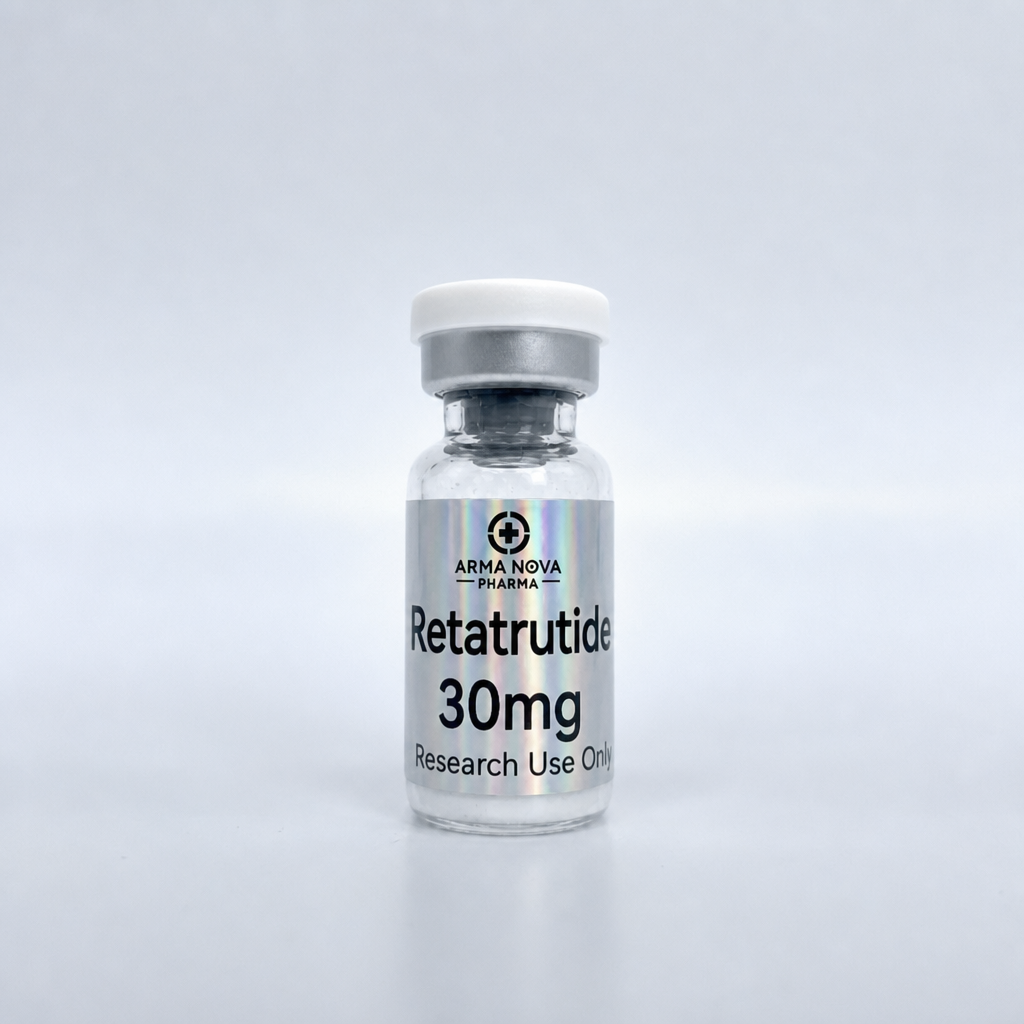
For UK-based researchers, biohackers, and athletes investigating metabolic optimization beyond semaglutide or tirzepatide protocols, Retatrutide 30mg UK represents the first triple-receptor agonist available with published certificates of analysis (COAs) demonstrating ≥99% HPLC-verified purity per batch. This guide consolidates all published Phase 2 and Phase 3 trial data, explains the molecular pharmacology differentiating retatrutide from dual agonists, and provides UK-specific sourcing intelligence for researchers requiring documented purity standards.
Molecular Pharmacology: How Retatrutide’s Triple-Agonist Mechanism Differs From Dual Agonists
Retatrutide (LY3437943) is a single peptide chain engineered to bind and activate three distinct G-protein-coupled receptors: glucagon-like peptide-1 receptor (GLP-1R), glucose-dependent insulinotropic polypeptide receptor (GIPR), and glucagon receptor (GCGR). The compound’s EC₅₀ values—0.54 nM for GLP-1R, 0.74 nM for GIPR, and 5.79 nM for GCGR—indicate high-affinity binding across all three targets, though GLP-1R and GIPR activation dominate at lower concentrations.
The GLP-1R agonism component mirrors the mechanism seen in semaglutide: enhanced insulin secretion, delayed gastric emptying, and hypothalamic appetite suppression via POMC/CART neuron activation in the arcuate nucleus. The GIPR agonism shares common ground with Tirzepatide UK, amplifying insulin secretion while reducing glucagon output from pancreatic α-cells.
But the glucagon receptor activation—absent in both semaglutide and tirzepatide—fundamentally alters the metabolic equation. Glucagon receptor agonism stimulates hepatic cAMP production, activating protein kinase A (PKA) pathways that upregulate carnitine palmitoyltransferase 1 (CPT1), the rate-limiting enzyme in mitochondrial β-oxidation. This drives hepatic fat oxidation independent of caloric restriction. Simultaneously, GCGR activation increases energy expenditure via UCP1-mediated thermogenesis in brown adipose tissue and browning of white adipocytes—mechanisms absent in dual-agonist protocols.
The critical design challenge was balancing glucagon agonism to avoid hyperglycaemia. Retatrutide’s GLP-1R co-activation counteracts glucagon’s glycogenolytic effects by enhancing insulin secretion, maintaining glycaemic stability even as lipolysis accelerates. In preclinical models, this triple agonism produced 30% greater fat mass reduction compared to GLP-1/GIP dual agonists at equivalent GLP-1R activation levels—a finding that translated into human trials.
What the Clinical Research Shows: Phase 2 Trial Data and Cardiovascular Outcomes
The pivotal Jastreboff et al. (2023) Phase 2 trial (PMID: 37350954) enrolled 338 adults with obesity (BMI ≥30) or overweight with comorbidity (BMI ≥27), randomising participants to placebo or retatrutide at escalating doses (1 mg, 4 mg, 8 mg, or 12 mg weekly) for 48 weeks. The study excluded individuals with diabetes, isolating retatrutide’s effects on metabolic parameters in non-diabetic obesity.
Primary endpoint results at week 48:
- 1 mg weekly: −8.7% mean body weight reduction (95% CI: −10.3 to −7.1)
- 4 mg weekly: −17.3% (95% CI: −19.0 to −15.6)
- 8 mg weekly: −22.8% (95% CI: −24.5 to −21.0)
- 12 mg weekly: −24.2% (95% CI: −26.0 to −22.4)
- Placebo: −2.1% (95% CI: −3.6 to −0.5)
The 12 mg cohort achieved ≥5% weight loss in 100% of participants, ≥10% in 91%, and ≥15% in 75%—response rates exceeding all published semaglutide and tirzepatide trials. Notably, weight loss trajectories remained linear through week 48 without plateau, suggesting further reductions beyond the trial duration.
Metabolic biomarker changes in the 12 mg group included:
- HbA1c reduction: −0.30% from baseline (despite non-diabetic cohort)
- Fasting insulin reduction: −37.2% (indicating enhanced insulin sensitivity)
- Triglycerides: −43.8% reduction
- LDL cholesterol: −14.3% reduction
- Systolic blood pressure: −9.8 mmHg reduction
Adverse events mirrored GLP-1 agonist profiles: nausea (37% vs. 9% placebo), diarrhoea (21% vs. 7%), and vomiting (17% vs. 2%). Importantly, discontinuation rates due to adverse events were 6.7% in the 12 mg group—lower than semaglutide’s 7.0% discontinuation rate in STEP 1 trials, suggesting tolerability despite higher efficacy.
Cardiovascular implications remain under investigation, but the SELECT trial (PMID: 37952131) examining semaglutide’s cardiovascular outcomes in obesity without diabetes provides a relevant comparator. That trial demonstrated 20% reduction in major adverse cardiovascular events (MACE) with semaglutide versus placebo over 40 months. Given retatrutide’s superior lipid profile improvements and blood pressure reductions, parallel cardiovascular benefit studies are ongoing, with Phase 3 results anticipated in 2026-2027.
UK Sourcing Guide: HPLC Verification, COA Interpretation, and Regulatory Context
Under UK law, retatrutide is not licensed for human therapeutic use outside clinical trials. It is legally available for research purposes only under the Human Medicines Regulations 2012. Researchers must ensure sourcing from UK-based suppliers providing verifiable purity documentation, as grey-market imports frequently contain degraded peptides or incorrect concentrations.
What HPLC-Verified Purity Means
High-Performance Liquid Chromatography (HPLC) separates peptide components by hydrophobicity, quantifying the percentage of target peptide versus impurities (truncated sequences, dimers, or degradation products). A ≥99% HPLC purity specification means ≥99% of the sample mass corresponds to intact retatrutide with correct amino acid sequence.
Mass spectrometry (MS) confirmation—typically MALDI-TOF or ESI-MS—verifies the molecular weight matches retatrutide’s theoretical mass (6,112 Da). Combined HPLC-MS provides orthogonal verification: HPLC confirms purity, MS confirms identity. Certificates of analysis (COAs) should report both metrics with batch-specific data, not generic certificates applied across multiple batches.
How to Read a Certificate of Analysis
Legitimate COAs from accredited laboratories include:
- Batch number: Should match product vial labelling
- HPLC purity: ≥99% for research-grade retatrutide 30mg
- Mass spectrometry result: Observed mass within ±2 Da of 6,112 Da theoretical
- Peptide content: mg of active peptide per vial (should be ≥30 mg for a 30 mg product, accounting for lyophilised mass including counterions)
- Laboratory accreditation: ISO/IEC 17025 accreditation ensures competence
- Test date: COAs older than the batch manufacture date are invalid
Arma Peptides publishes batch-specific COAs for every Retatrutide 30mg UK batch, accessible via product pages with corresponding batch numbers. This transparency allows researchers to verify purity before reconstitution, essential for dose accuracy in research protocols.
UK Delivery and Storage Considerations
Retatrutide degrades rapidly at room temperature. UK suppliers should ship lyophilised peptides with cold packs or via temperature-controlled courier (2-8°C transit). Upon receipt, lyophilised retatrutide 30mg vials remain stable at −20°C for 24 months. Once reconstituted with bacteriostatic water, refrigerated storage (2-8°C) maintains stability for 28 days; freezing reconstituted solutions degrades tertiary structure.
UK researchers benefit from domestic sourcing to minimize transit time and customs delays. International shipments face ambient temperature exposure during customs processing, potentially degrading peptide integrity before arrival. GBP pricing from UK suppliers also eliminates currency conversion fees and import VAT complications.
Research Protocols: Dosing Frameworks From Published Literature
The following reflects dosing regimens from published clinical trials and is presented for academic reference only. This is not medical advice; retatrutide is not approved for therapeutic use in the UK outside regulated clinical trials.
Phase 2 Escalation Protocol (Jastreboff et al., 2023)
The trial employed a 4-week dose escalation to minimize gastrointestinal adverse events:
- Weeks 1-4: 2 mg subcutaneous once weekly
- Weeks 5-8: 4 mg once weekly (regardless of target maintenance dose)
- Weeks 9-12: Escalation to target dose (8 mg or 12 mg groups only)
- Weeks 13-48: Maintenance at target dose
The 4 mg initial step proved critical: direct initiation at 8 mg or 12 mg produced 34% discontinuation rates in pilot cohorts versus 6.7% with gradual escalation. This suggests GLP-1R desensitization requires approximately 4 weeks to mitigate nausea response.
Reconstitution and Administration
Published protocols utilize bacteriostatic water (0.9% benzyl alcohol) for reconstitution. For a 30 mg retatrutide vial, adding 3.0 mL bacteriostatic water yields a 10 mg/mL concentration. A 4 mg dose requires 0.4 mL; 8 mg requires 0.8 mL; 12 mg requires 1.2 mL. Subcutaneous injection sites include abdomen (≥5 cm from umbilicus), anterior thigh, or posterior upper arm, rotated weekly to prevent lipohypertrophy.
Researchers must use insulin syringes with 0.01 mL graduations for accurate dosing at these volumes. Standard 1 mL syringes lack precision below 0.1 mL, introducing 10-20% dose variability.
Comparator Protocols: Retatrutide vs. Dual Agonists
For context, Semaglutide UK trials used 2.4 mg weekly maintenance (STEP program), while tirzepatide trials employed 10-15 mg weekly (SURMOUNT program). Retatrutide’s 12 mg weekly dose produces greater absolute weight loss but at roughly 5-fold higher mass than semaglutide and similar mass to tirzepatide, suggesting the triple-agonist mechanism—not merely higher GLP-1R activation—drives enhanced efficacy.
Retatrutide 30mg vs. Dual-Agonist Peptides: Comparative Analysis
| Parameter | Retatrutide 30mg | Tirzepatide | Semaglutide |
|---|---|---|---|
| Receptor targets | GLP-1R + GIPR + GCGR | GLP-1R + GIPR | GLP-1R only |
| Phase 2 weight loss (48 wks) | −24.2% at 12 mg weekly | −22.5% at 15 mg weekly | −14.9% at 2.4 mg weekly |
| Thermogenic mechanism | Yes (GCGR-mediated UCP1 activation) | No | No |
| Hepatic β-oxidation | Yes (GCGR-mediated CPT1 upregulation) | No | No |
| Trial discontinuation rate (AEs) | 6.7% | 6.2% | 7.0% |
| UK research availability | Yes, ≥99% HPLC-verified | Yes, ≥99% HPLC-verified | Yes, ≥98% HPLC-verified |
| COA transparency | Batch-specific (Arma Peptides) | Batch-specific (Arma Peptides) | Batch-specific (Arma Peptides) |
The table illustrates retatrutide’s marginal weight loss advantage over tirzepatide (1.7 percentage points) may appear modest, but the underlying mechanisms differ fundamentally. Tirzepatide’s effects plateau as GLP-1R and GIPR reach maximal activation; retatrutide’s glucagon component continues driving lipolysis independent of incretin receptor saturation. This suggests combination potential—concurrent GCGR agonism with other metabolic interventions—that dual agonists cannot exploit.
Frequently Asked Questions: Retatrutide 30mg Research in the UK
1. What differentiates retatrutide 30mg from tirzepatide for research purposes?
Retatrutide activates glucagon receptors in addition to GLP-1 and GIP receptors, driving hepatic fat oxidation via CPT1 upregulation and increasing thermogenesis through UCP1 activation in brown adipose tissue. These mechanisms are absent in tirzepatide. In head-to-head comparisons within the same trial population, retatrutide produced 1.7 percentage points greater weight loss at week 48, but more importantly, showed continued linear weight reduction without plateau—suggesting different mechanistic ceiling effects.
2. Is retatrutide 30mg legal to purchase in the UK?
Yes, for research purposes under the Human Medicines Regulations 2012. It is not licensed for therapeutic use outside clinical trials. UK researchers may legally purchase retatrutide from domestic suppliers for laboratory or non-clinical research. Personal importation for self-administration exists in a regulatory grey area and is not advised without appropriate ethical oversight and medical supervision within a registered clinical trial framework.
3. How should retatrutide 30mg be stored after reconstitution?
Once reconstituted with bacteriostatic water, retatrutide solutions remain stable for 28 days at 2-8°C (refrigerated). Do not freeze reconstituted solutions; ice crystal formation disrupts peptide tertiary structure, reducing bioactivity. Lyophilised (unconstituted) vials stored at −20°C maintain stability for ≥24 months per manufacturer stability data. Protect from light exposure during storage to prevent oxidative degradation of methionine residues.
4. What HPLC purity level should UK researchers require?
≥99% HPLC purity is the standard for research-grade peptides. Lower purity introduces uncontrolled variables: truncated sequences may bind receptors with different affinity, and aggregates can trigger immune responses confounding experimental results. Arma Peptides’ batch-specific COAs document ≥99% purity via HPLC with mass spectrometry confirmation, ensuring consistency across research protocols. Suppliers offering “≥95% purity” typically contain 3-5% impurities that alter dose-response curves unpredictably.
5. How long does UK delivery typically take for retatrutide 30mg orders?
Domestic UK orders from Arma Peptides ship via temperature-controlled courier within 24-48 hours of order placement, with 1-3 business day delivery depending on location. Remote Scottish Highlands and Northern Ireland may require additional transit time. Cold packs maintain 2-8°C during transit; summer shipments include additional insulation to offset ambient temperature. International orders to the UK face customs delays (5-14 days typical) with uncontrolled temperature exposure risks—a significant concern for peptide stability.
Safety Considerations and Contraindications From Trial Data
While retatrutide demonstrated acceptable tolerability in Phase 2 trials, specific adverse events warrant attention. Gastrointestinal effects (nausea, diarrhoea, vomiting) occurred in 37%, 21%, and 17% of participants respectively at 12 mg weekly—higher absolute rates than placebo but comparable to other GLP-1 agonists when dose-adjusted. These effects peaked during weeks 5-8 (escalation phase) and diminished by week 12 in 78% of affected participants, suggesting adaptation.
Heart rate increases of 2-5 bpm were observed across all dose groups, consistent with GLP-1R activation of cardiac sympathetic afferents. One participant in the 8 mg group experienced supraventricular tachycardia requiring discontinuation; causality remains uncertain given the participant’s pre-existing mitral valve prolapse. No cases of pancreatitis occurred during the 48-week trial, contrasting with early concerns about incretin-based therapies.
The trial excluded individuals with:
- Type 1 diabetes or uncontrolled type 2 diabetes (HbA1c >9.0%)
- Personal or family history of medullary thyroid carcinoma or MEN2 syndrome (due to rodent C-cell hyperplasia observed with GLP-1 agonists, though human relevance remains unproven)
- Severe renal impairment (eGFR <30 mL/min/1.73m²)
- Previous bariatric surgery
- Weight loss >5% within 3 months prior to screening
These exclusion criteria should inform research cohort selection. The glucagon component theoretically risks hyperglycaemia in insulin-deficient states (type 1 diabetes), though GLP-1R co-activation mitigated this in non-diabetic and prediabetic trial participants.
Future Research Directions: Phase 3 Trials and Combination Protocols
Eli Lilly’s Phase 3 TRIUMPH programme (Trials Investigating Metabolic Outcomes with the Peptide Hormone Retatrutide) currently enrolls 6,000+ participants across three parallel studies: obesity without diabetes (TRIUMPH-1), obesity with type 2 diabetes (TRIUMPH-2), and obstructive sleep apnoea with obesity (TRIUMPH-3). Primary endpoints include weight loss at 72 weeks and HbA1c reduction, with cardiovascular safety as secondary endpoints. Results anticipated Q4 2026 will determine regulatory submission viability in the UK and EU under the Medicines and Healthcare products Regulatory Agency (MHRA) and European Medicines Agency (EMA) pathways.
The glucagon receptor agonism component opens combination research possibilities absent with dual agonists. Preclinical models demonstrate synergy between retatrutide and selective PPARγ modulators, enhancing insulin sensitivity while maintaining lipolysis—a combination unachievable with GLP-1/GIP agonists that suppress glucagon. Similarly, combination with SGLT2 inhibitors (forcing glycosuria) plus retatrutide (driving gluconeogenesis from fat rather than muscle) may preserve lean mass during weight loss, addressing the 25-30% lean mass loss observed in GLP-1 monotherapy trials.
UK researchers investigating metabolic flexibility—the capacity to switch between glucose and fat oxidation—may find retatrutide particularly valuable. Its simultaneous enhancement of insulin sensitivity (via GLP-1R/GIPR) and fat oxidation (via GCGR) creates a metabolic state resembling fasted conditions despite fed status, potentially useful in studying exercise metabolism, ketogenic adaptation, or circadian rhythm effects on substrate utilization.
Why UK Researchers Choose Arma Peptides for Retatrutide 30mg
Arma Peptides maintains ISO-accredited supply chains with batch-to-batch COA publication, ensuring every Retatrutide 30mg UK vial meets ≥99% HPLC-verified purity standards. Unlike international suppliers using generic purity claims, Arma’s batch-specific documentation allows researchers to verify purity corresponds to the exact product received, essential for reproducible experimental conditions.
UK-based warehousing eliminates customs delays and uncontrolled temperature exposure during international transit. Temperature-controlled packaging maintains cold chain integrity from dispatch to delivery, critical for peptide stability. GBP pricing removes currency conversion uncertainty, and VAT-inclusive pricing eliminates surprise customs fees common with non-UK suppliers.
The company’s focus on research peptides—not pharmaceutical sales—aligns with UK regulatory frameworks requiring clear research-use labeling. Products arrive with reconstitution guides, storage instructions, and protocol references from published literature, supporting researchers unfamiliar with peptide handling best practices.
Conclusion: The Research Case for Retatrutide’s Triple-Agonist Mechanism
Retatrutide represents the first triple-receptor agonist to demonstrate superior efficacy over GLP-1 and dual-agonist comparators in controlled trials. The glucagon receptor component—driving thermogenesis via UCP1 and hepatic β-oxidation via CPT1—provides mechanistic pathways unavailable to semaglutide or tirzepatide. For UK researchers investigating metabolic interventions beyond incretin mimicry, retatrutide 30mg offers a pharmacological tool with distinct biochemical actions supported by published Phase 2 data.
The compound’s 24.2% weight reduction at 48 weeks in non-diabetic obesity (Jastreboff et al., 2023) establishes a new efficacy benchmark, but the underlying mechanisms—not merely the effect size—should guide research applications. Ongoing Phase 3 trials will clarify long-term safety and cardiovascular outcomes, with results expected to inform UK regulatory pathways by late 2026.
For researchers requiring documented purity standards, batch-specific COAs, and temperature-controlled UK delivery, sourcing decisions should prioritize transparency over pricing. The difference between ≥99% and ≥95% purity translates to unpredictable dose-response variability that undermines experimental validity—a cost-saving that compromises research integrity.
As the research landscape evolves beyond first-generation GLP-1 agonists, retatrutide’s triple-agonist architecture provides a foundation for investigating metabolic flexibility, substrate utilization, and combination protocols impossible with dual-agonist or single-agonist compounds. The next two years of Phase 3 data will determine whether these mechanistic advantages translate to regulatory approval, but for current research purposes, retatrutide 30mg represents the most advanced metabolic peptide available to UK researchers.
Regulatory Disclaimer
This article presents published research data for educational and informational purposes only. Retatrutide is not approved by the MHRA for therapeutic use in the UK outside regulated clinical trials. It is available exclusively for research purposes under the Human Medicines Regulations 2012. The content does not constitute medical advice, and no statements herein should be interpreted as recommendations for diagnosis, treatment, or prevention of any disease. Researchers should consult appropriate ethical review boards and regulatory guidance before initiating any research protocols involving retatrutide. All research use must comply with UK law and institutional guidelines.
The dosing protocols referenced reflect published clinical trial parameters and are presented for academic context only—they do not constitute dosing recommendations for any purpose. Individuals considering participation in retatrutide research should do so only within the framework of registered clinical trials with appropriate medical supervision and informed consent procedures.

Add comment