
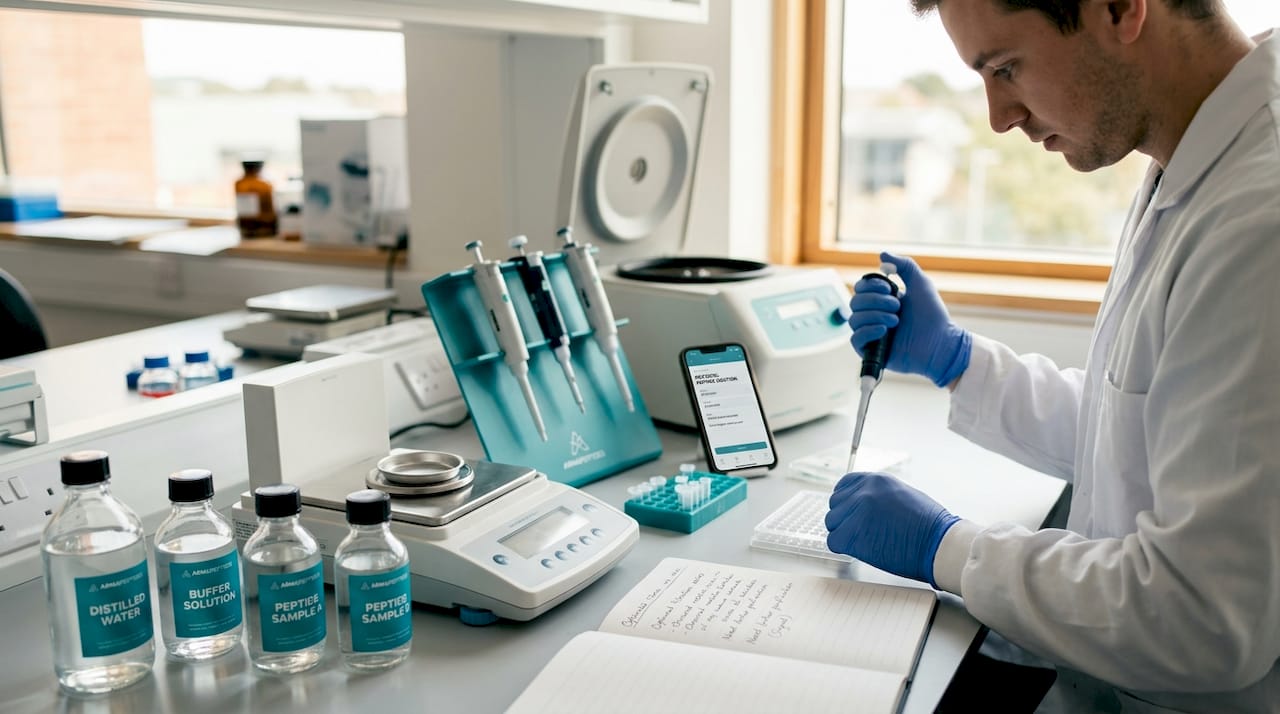
Peptide sample preparation is defined as the set of physical and chemical processes applied to a peptide-containing specimen before downstream biochemical or mass spectrometric analysis. Correct execution of these processes determines whether your data reflects true peptide identity and quantity, or artefacts introduced by salts, ion-pairing agents, and matrix contaminants. This peptide sample preparation lab guide covers the complete workflow: from selecting consumables and performing C18 StageTip desalting, to automated SPE with Biotage PhyTip columns, advanced counterion exchange, and the documentation standards that make results reproducible across operators and instrument runs. Researchers working in proteomics, pharmacology, and molecular biology will find specific protocols, comparison data, and troubleshooting guidance throughout.
What materials and equipment are required for peptide sample preparation?
Effective sample preparation methods begin with the right consumables and instrumentation. Cutting corners on reagent grade or tip format introduces variability that no downstream correction can fix.
Core consumables
- C18 StageTips (Empore C18 membrane discs, 1-3 discs per tip depending on sample load)
- SPE columns: Biotage PhyTip C18 (90Å for standard peptides, 300Å for larger peptides above 3 kDa)
- Solvents: LC-MS grade acetonitrile (ACN), LC-MS grade water, trifluoroacetic acid (TFA), formic acid, acetic acid
- Buffers: ammonium acetate or ammonium phosphate at 10-50 mM for WCX workflows
- Low-binding microcentrifuge tubes (1.5 mL and 0.5 mL)
- Sealed 96-well collection plates for automated workflows
Instrumentation
- Benchtop microcentrifuge capable of 1,000-1,500×g
- Vacuum concentrator (e.g., SpeedVac) for post-elution drying
- Calibrated single-channel and multichannel pipettes
- Vortex mixer
- pH meter or narrow-range pH strips (pH 1-4)
Solvent purity is not optional. LC-MS grade solvents contain fewer than 1 ppb of UV-absorbing contaminants, which matters when you are quantifying peptides at nanogram inputs. Using HPLC grade instead of LC-MS grade introduces baseline noise that obscures low-abundance species.
Pro Tip: Match your tip format to your sample volume. A single Empore C18 disc handles up to 200 µL load volume reliably. For volumes above that, stack two discs or switch to a 96-well SPE plate format to avoid overloading the sorbent and losing recovery.
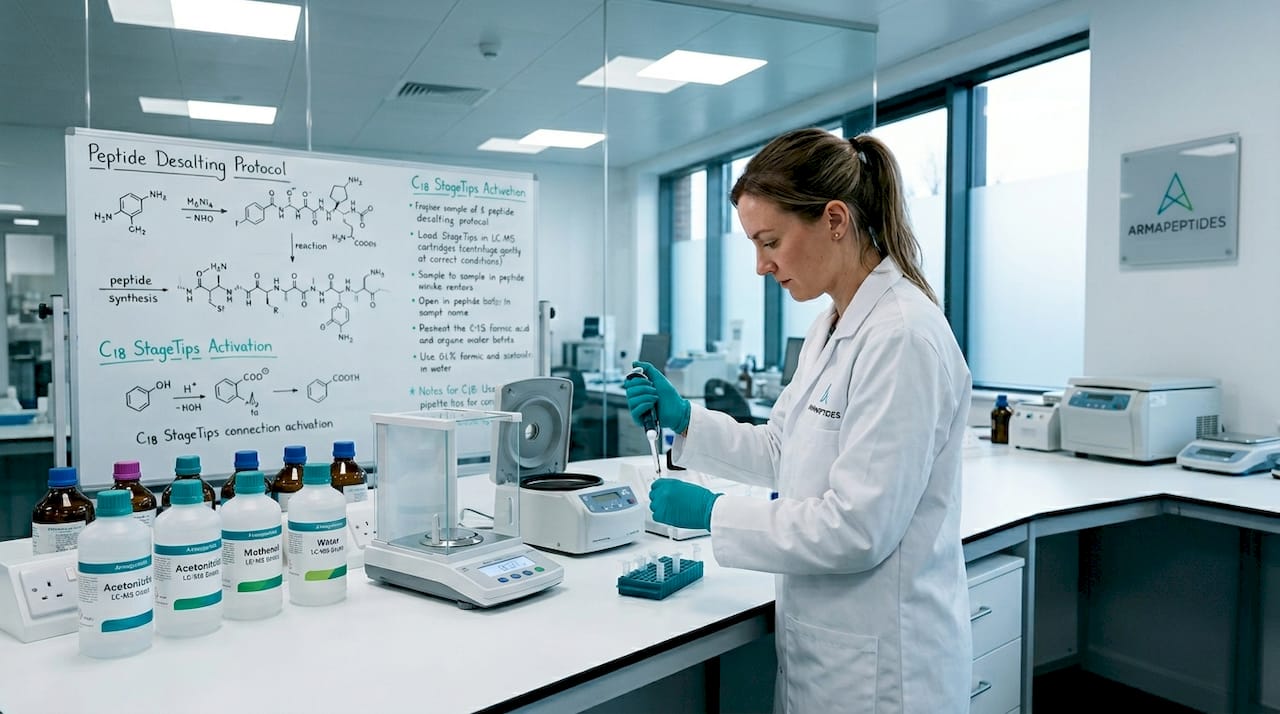
How to desalt peptides using C18 StageTips: step-by-step protocol
C18 StageTip desalting is the most widely used cleanup method in bottom-up proteomics and synthetic peptide analysis. The protocol relies on reversed-phase retention of hydrophobic peptides while salts and hydrophilic matrix components pass through.
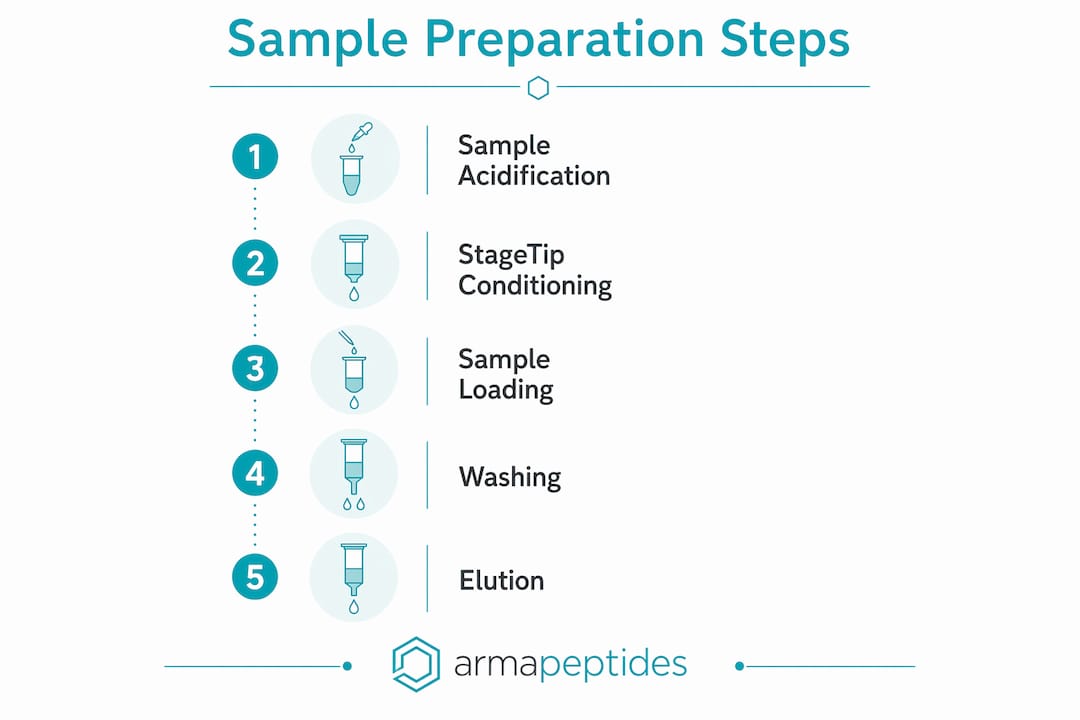
Sample acidification
Acidification is the single most critical pre-step. Sample acidification to pH ≤3 using 0.5-1% TFA is required for efficient peptide binding to C18 resin. At higher pH values, peptide-resin interaction weakens and recovery drops substantially. Add 2% TFA in a 1:3 ratio to your sample and verify pH with a strip before proceeding.
Step-by-step procedure
- Condition the StageTip with 100 µL of 100% methanol. Centrifuge at 1,000-1,500×g for 1 minute. Discard the flow-through.
- Equilibrate with 100 µL of 0.1% TFA in LC-MS water. Centrifuge at 1,000-1,500×g for 1 minute. Discard the flow-through.
- Load the acidified sample (≤200 µL per StageTip). Centrifuge at 1,000×g for 2-3 minutes. Retain the flow-through for recovery checks if needed.
- Wash with 100 µL of 0.1% TFA in LC-MS water. Centrifuge at 1,000×g for 1 minute. Discard the wash.
- Elute with 50-80 µL of 60-80% ACN in 0.1% TFA. Centrifuge at 1,000×g for 1 minute. Collect the eluate.
- Dry the eluate in a vacuum concentrator at 45°C until the volume is reduced to near-dryness. Reconstitute in your desired LC-MS loading buffer.
Critical handling notes
Do not allow the C18 membrane to dry between steps. Drying causes irreversible collapse of the sorbent bed, which reduces surface area and peptide recovery. Work quickly between washes, or keep the tip submerged in buffer if there is a delay.
Pro Tip: If you observe a precipitate in your acidified sample, centrifuge at 14,000×g for 5 minutes and transfer the supernatant before loading onto the StageTip. Particulates block the membrane and cause inconsistent flow rates.
| Step | Reagent | Volume | Centrifuge speed |
|---|---|---|---|
| Condition | 100% methanol | 100 µL | 1,000-1,500×g, 1 min |
| Equilibrate | 0.1% TFA in water | 100 µL | 1,000-1,500×g, 1 min |
| Load | Acidified sample | ≤200 µL | 1,000×g, 2-3 min |
| Wash | 0.1% TFA in water | 100 µL | 1,000×g, 1 min |
| Elute | 60-80% ACN, 0.1% TFA | 50-80 µL | 1,000×g, 1 min |
How do manual StageTips and automated PhyTip SPE columns compare?
When throughput exceeds 24 samples per run, manual StageTip processing becomes a bottleneck. Biotage PhyTip C18 columns address this through automated aspirate-and-expel cycles on liquid-handling platforms.
PhyTip column operation
Biotage PhyTip columns perform desalting through multiple aspirate/expel cycles at a controlled flow rate of 1 mL/min. Elution uses 100 µL of 70% ACN with 0.1% TFA across four cycles. Sealed collection plates prevent evaporation between steps, which is a source of variability that manual workflows cannot easily control. Timed pauses between cycles allow the sorbent to equilibrate fully, producing consistent backpressure and reproducible recovery across a 96-well plate.
The resin choice depends on peptide size. The 90Å pore size suits peptides below 3 kDa, where surface area maximisation drives recovery. The 300Å pore size accommodates larger peptides and small proteins where diffusion into narrow pores would otherwise limit binding.
Comparison: manual ZipTip vs automated PhyTip
| Parameter | Manual ZipTip/StageTip | Automated PhyTip |
|---|---|---|
| Throughput | 8-24 samples per hour | 96 samples per run |
| Reproducibility | Operator-dependent | Instrument-controlled |
| Evaporation control | Manual (variable) | Sealed plates (consistent) |
| Flow rate control | Centrifuge speed | Programmed 1 mL/min |
| Suitable sample input | 1-50 µg | 1-100 µg |
Automation adds reproducibility in SPE workflows, but it demands precise control of flow rates and buffer handling to avoid variability. A poorly programmed aspiration pause introduces the same inconsistency as an inattentive manual operator.
Pro Tip: When transitioning from manual to automated SPE, validate the automated method against your existing manual protocol using a known peptide standard at your typical input mass. Recovery should be within 10% before switching production samples.
What advanced purification techniques improve peptide purity and assay compatibility?
Standard C18 desalting removes salts and hydrophilic contaminants, but it does not address two specific problems: residual trifluoroacetate from solid-phase peptide synthesis (SPPS) and co-eluting hydrophobic matrix components. These require targeted approaches.
Counterion exchange via RP-SPE
Synthetic peptides produced by SPPS are obtained as trifluoroacetate salts. TFA residuals interfere with MS ionisation and can suppress signal in ESI sources. RP-SPE counterion exchange replaces TFA with hydrochloride or acetate in a single chromatographic step, achieving purity up to 97% and reducing TFA content below 0.36%. The workflow combines purification and counterion exchange, eliminating the need for separate lyophilisation and reconstitution cycles.
The procedure uses a solvent gradient from aqueous TFA to ACN-based eluents, with conditioning steps that saturate the resin with the target counterion before elution. This is distinct from standard desalting and should be applied specifically when downstream assays involve ESI-MS or cell-based bioassays sensitive to TFA.
Mixed-mode weak cation exchange (WCX) SPE
WCX SPE exploits both ionic and hydrophobic interactions simultaneously, making it particularly effective for peptides that co-elute with hydrophobic matrix contaminants in standard RP-SPE.
The key steps in a WCX workflow are:
- Condition the cartridge with organic solvent, then equilibrate with loading buffer (ammonium acetate or phosphate, 10-50 mM, pH 4-6).
- Load the sample at pH below the peptide pI to promote ionic interaction between the positively charged peptide and the cation exchange resin.
- Wash with aqueous buffer to remove inorganic salts.
- Wash with a low-concentration organic solvent to remove hydrophobic contaminants without disrupting ionic binding.
- Elute with a mild acidic organic solvent (e.g., 5% formic acid in 50% ACN) to simultaneously disrupt ionic and hydrophobic interactions.
Recovery validation after WCX should use UV absorbance at 214 nm or a fluorescence-based peptide quantification assay. If recovery falls below 70%, re-examine loading pH, as values above the peptide pI reduce ionic retention and allow premature elution during the wash step.
How should peptide sample preparation be documented for reproducibility?
Documentation is the mechanism by which a single researcher’s protocol becomes a laboratory standard. Without it, even technically sound preparation methods produce results that cannot be compared across runs or operators.
The variables that must be captured go beyond the obvious. Dilution chains, intermediate containers, and preparation-to-use timings measurably influence peptide assay results and must be formally recorded. A sample prepared and used within 30 minutes behaves differently from one left at room temperature for two hours before loading, even if all other parameters are identical.
Minimum documentation fields for each preparation run
- Peptide identity: name, catalogue number, batch ID, and supplier
- Receiving date and storage location (temperature, container type)
- Preparation date and operator identifier
- Reconstitution solvent, volume, and final concentration
- Dilution chain: each intermediate concentration, container type, and transfer volume
- Preparation-to-analysis interval
- Deviations from the standard operating procedure, with reason and outcome
“Standardised identity-field anchoring and handling-note normalisation reduce variability due to administration, not just chemistry.” — Umbrella Labs documentation framework, 2026
Consistent naming conventions across all fields prevent ambiguity when reviewing historical data. A batch ID that includes the supplier code, synthesis lot, and internal receipt number allows traceability back to the original certificate of analysis, which is necessary for any publication-grade quality control.
Key takeaways
Reproducible peptide sample preparation requires matched consumables, controlled acidification, and formal documentation of every preparation variable from batch ID to analysis interval.
| Point | Details |
|---|---|
| Acidification is non-negotiable | Adjust sample pH to ≤3 with TFA before loading onto any C18 sorbent to achieve reliable binding. |
| Match sorbent to peptide size | Use 90Å pore C18 for peptides below 3 kDa and 300Å pore resin for larger peptides to maximise recovery. |
| Counterion exchange is separate from desalting | SPPS-derived peptides require RP-SPE counterion exchange to reduce TFA below 0.36% for ESI-MS compatibility. |
| Automation requires validation | Automated PhyTip workflows must be validated against manual protocols before processing production samples. |
| Documentation drives reproducibility | Record dilution chains, intermediate containers, and preparation-to-use timings as formally as chemical parameters. |
Why documentation and consumable choice matter more than researchers expect
Elizabeth’s perspective
After working through dozens of proteomics and synthetic peptide projects, the failures I have seen most often trace back not to the chemistry but to two underestimated factors: consumable microstructure and documentation gaps.
On consumables: subtle physical differences in StageTip media affect peptide identification rates at low nanogram inputs. Two C18 tips from different manufacturers look identical but produce measurably different recovery at 20 ng input. Most labs discover this only when a batch changes and results shift unexpectedly. My recommendation is to qualify a single consumable lot for any experiment where input mass is below 50 ng, and to document the lot number alongside every preparation record.
On ion-pairing agents: TFA is highly effective for peptide binding but carries a real cost in ESI-MS workflows. I have seen researchers spend days troubleshooting ion suppression that was entirely attributable to residual TFA carried through insufficient washing. Switching the final wash to 0.1% formic acid rather than 0.1% TFA resolves this in most cases without sacrificing binding efficiency.
The documentation point is the one I feel most strongly about. Researchers treat it as administrative overhead, but it is actually the primary mechanism for distinguishing a chemistry problem from an administration problem. When results are inconsistent, the first question should be whether the preparation records are complete enough to rule out handling variability. In most labs, they are not.
— Elizabeth
Source your research peptides from Armapeptides
Reliable sample preparation begins with reliable starting material. Armapeptides supplies high-purity research peptides to laboratories and institutions across the UK and Europe, with each batch selected for purity, consistency, and traceability. Every compound is accompanied by documentation that supports your own preparation records, including batch identifiers and quality data. Whether you are working with standard research peptides or sourcing specific compounds for pharmacological studies, Armapeptides provides the materials and product information your workflow requires. Visit the Armapeptides peptide catalogue to review available compounds, or explore trusted UK supplier resources to support your sourcing decisions.
FAQ
What pH is required for C18 StageTip peptide binding?
Samples must be acidified to pH ≤3, typically using 0.5-1% TFA, before loading onto C18 StageTips. Insufficient acidification reduces peptide-resin interaction and lowers recovery.
When should counterion exchange be used instead of standard desalting?
Counterion exchange is required when peptides are synthesised by SPPS and carry trifluoroacetate residuals that would suppress ionisation in ESI-MS or interfere with cell-based bioassays. Standard C18 desalting does not remove TFA effectively.
What is the difference between 90Å and 300Å C18 resin for peptide SPE?
The 90Å pore size maximises surface area for peptides below 3 kDa, while the 300Å pore size accommodates larger peptides and small proteins that cannot diffuse into narrower pores. Selecting the wrong pore size reduces binding capacity and recovery.
How does WCX SPE differ from reversed-phase SPE for peptide cleanup?
WCX SPE uses both ionic and hydrophobic interactions to retain peptides, allowing selective removal of hydrophobic contaminants that co-elute with peptides in standard RP-SPE. Loading pH must be below the peptide pI to activate ionic retention.
What documentation fields are required for reproducible peptide preparation?
Batch ID, receiving date, reconstitution solvent and volume, full dilution chain, intermediate container types, preparation-to-analysis interval, and any deviations from the standard protocol must all be recorded formally for each preparation run.




Add comment