

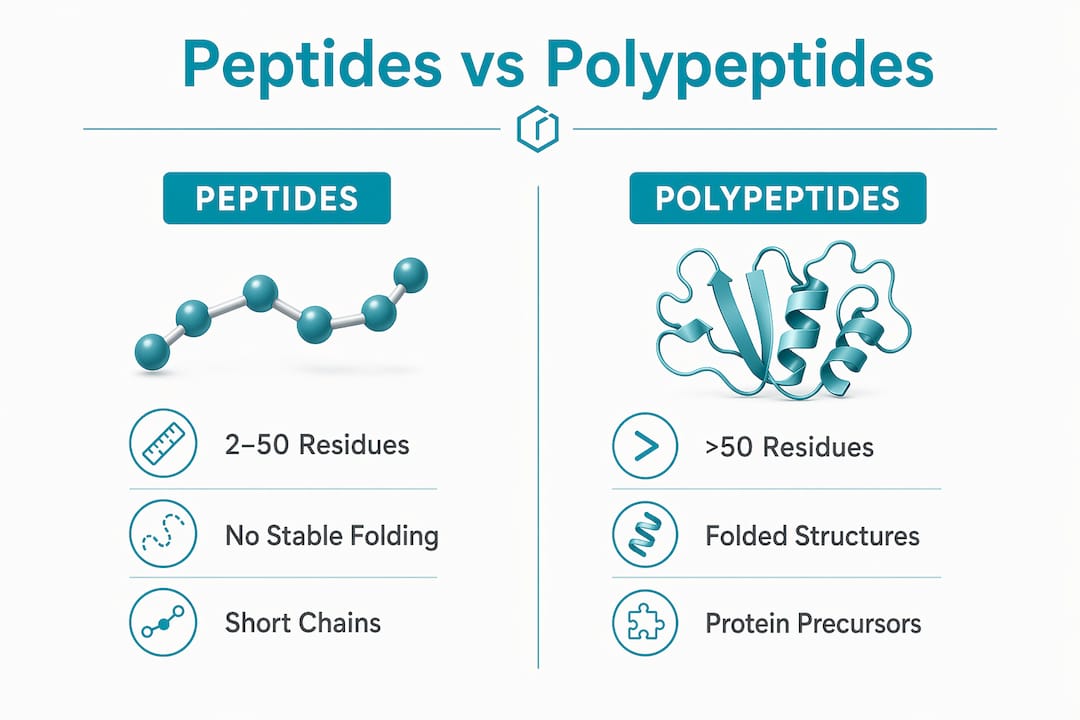
A peptide is a short chain of amino acids, typically between 2 and 50 residues linked by peptide bonds, while a polypeptide is a longer chain of more than 50 residues capable of folding into stable three-dimensional structures. Understanding what is polypeptide versus peptide research is not merely a matter of nomenclature. The distinction carries direct consequences for experimental design, synthesis strategy, regulatory classification, and data interpretation. For researchers in molecular biology and biochemistry, clarity on this boundary is foundational to working with these molecules effectively.
What is polypeptide versus peptide research: core definitions
Peptide research, as defined by Genome.gov (NIH), concerns amino acid chains of 2 to 50 residues. This range covers a biologically significant class of molecules that includes signalling peptides, regulatory hormones such as oxytocin, and antimicrobial agents. The peptide versus polypeptide distinction is largely a convention based on residue length, meaning context and source determine specific definitions in practice. Researchers must therefore apply these terms with awareness of which authority or regulatory body is setting the boundary.
Polypeptides, by contrast, are defined as chains exceeding 50 residues. Their greater length creates the physical basis for secondary structures such as alpha helices and beta sheets, and ultimately for tertiary folding into functional proteins. Not every polypeptide becomes a protein. A polypeptide achieves protein status only when it folds stably into a defined three-dimensional conformation, often with the assistance of molecular chaperones. This folding requirement is what separates a structural or enzymatic protein from an unfolded or partially folded polypeptide chain.

What are peptides: structure, length, and biological roles
Peptides occupy a structurally simpler but functionally diverse space in molecular biology. Their defining characteristics include:
- Chain length: 2 to 50 amino acid residues
- Structural complexity: generally lacking stable secondary or tertiary structure under physiological conditions
- Biological origins: cleavage of precursor proteins, translation from small open reading frames (sORFs), or direct enzymatic synthesis
- Primary functions: cell signalling, hormonal regulation, antimicrobial activity, and neurotransmission
A 2025 PMC review confirms that peptides function as signalling and regulatory molecules arising from diverse biosynthetic routes, including post-translational modification of larger precursors. This diversity challenges the notion of a fixed peptide definition and expands the functional scope of peptide research considerably. Researchers working with sORF-derived peptides, for instance, encounter molecules with regulatory roles that were largely unrecognised a decade ago.
Chemical synthesis of peptides for research purposes is well established. Solid-phase peptide synthesis (SPPS) allows the sequential addition of protected amino acids to a resin-bound chain, producing sequences of defined composition with high reproducibility. Solution-phase synthesis remains an alternative for certain shorter sequences or industrial-scale production. Both approaches yield peptides suitable for in vitro and in vivo research applications.
Pro Tip: Peptide solubility varies considerably by sequence composition. Hydrophobic-rich sequences often require solubilisation in dimethyl sulphoxide (DMSO) before aqueous dilution, whilst charged sequences may dissolve directly in water or dilute acetic acid. Validate your solubilisation protocol per sequence rather than applying a universal method.
How polypeptides differ from peptides in structure and function
The primary structural distinction between peptides and polypeptides is residue count, but the functional implications of that boundary are substantial. The table below summarises the key differences relevant to research contexts.
| Feature | Peptide | Polypeptide |
|---|---|---|
| Residue count | 2 to 50 amino acids | More than 50 amino acids |
| Structural complexity | Minimal secondary structure | Capable of secondary and tertiary folding |
| Biological role | Signalling, regulation, antimicrobial | Enzymatic, structural, hormonal (as proteins) |
| Synthesis approach | SPPS or solution-phase | Recombinant expression or extended SPPS |
| Regulatory classification | Small molecule or peptide drug | Biologic or large molecule |
| Folding requirement | Not required for function | Required for protein-level activity |
Polypeptides fold into stable secondary and tertiary structures, becoming functional proteins. Peptides generally do not achieve this level of structural organisation. This distinction is not trivial for researchers. An enzyme is a folded polypeptide; its catalytic activity depends entirely on the precise geometry of its active site, which only exists in the folded state. A signalling peptide such as glucagon-like peptide-1 (GLP-1), by contrast, exerts its effect through receptor binding without requiring stable tertiary folding.
Polypeptides also serve as protein precursors. Newly synthesised polypeptide chains emerging from the ribosome are unfolded and require chaperone-assisted folding to reach their functional conformation. Misfolded polypeptide chains contribute to diseases such as Alzheimer’s, Parkinson’s, and type 2 diabetes, where aggregation of misfolded proteins underlies pathology. This connection between polypeptide folding fidelity and disease makes the study of polypeptide structure directly relevant to translational research.
All proteins are polypeptides, but not all polypeptides are proteins. A polypeptide that fails to fold, or that is studied in its unfolded state, remains a polypeptide in the research context. Researchers should apply this distinction consistently when reporting experimental findings to avoid ambiguity in the literature.
Synthesis methods for peptides and polypeptides in research
Selecting the correct synthesis approach for a given molecule is one of the most consequential decisions in peptide and polypeptide research. The method determines yield, purity, scalability, and cost.
- Solid-phase peptide synthesis (SPPS): The dominant method for peptides up to approximately 50 residues. Fmoc-SPPS is the most widely used variant, offering compatibility with a broad range of protecting group strategies and automated synthesisers.
- Solution-phase synthesis: Preferred for large-scale production of shorter peptides or when SPPS resin loading presents limitations. Convergent solution-phase approaches allow fragment coupling for longer sequences.
- Recombinant expression: The standard route for polypeptides exceeding 50 residues. Expression in bacterial systems such as Escherichia coli, yeast, or mammalian cell lines allows production of correctly folded polypeptides with post-translational modifications where required.
- Photocatalytic and electrochemical methods: Emerging approaches reviewed in a 2025 IOPscience publication demonstrate that newer catalytic synthesis techniques improve efficiency and sustainability compared to classical methods, reducing reliance on hazardous reagents and improving atom economy.
- Native chemical ligation: Allows the coupling of unprotected peptide segments in aqueous conditions, extending the accessible chain length for chemical synthesis beyond the typical SPPS ceiling.
The choice of synthesis method significantly impacts research efficiency and sustainability, with newer catalytic and photochemical approaches gaining traction in academic and industrial laboratories. For drug development contexts, synthesis method also affects regulatory submissions, as manufacturing process consistency is a requirement for both peptide drugs and biologics.
Pro Tip: When synthesising sequences longer than 30 residues by SPPS, consider incorporating microwave-assisted coupling steps to reduce aggregation on-resin and improve overall yield. Sequences with consecutive hydrophobic residues are particularly prone to on-resin aggregation and benefit from pseudoproline dipeptide incorporation.
Applications of peptide and polypeptide research in molecular biology and therapeutics
Peptide and polypeptide research underpins a broad range of applications across molecular biology, pharmacology, and drug development. Key application areas include:
- Peptide therapeutics: Short peptides such as insulin analogues, GLP-1 receptor agonists, and antimicrobial peptides are established or investigational drugs. Their small size relative to biologics simplifies manufacturing but introduces stability challenges in physiological environments.
- Polypeptide-based drug delivery: A 2026 Nature Communications study reports that polypeptide lipid nanoparticles based on biodegradable poly(D,L-serine) components offer improved stability and reduced immunogenicity compared to PEGylated analogues for mRNA delivery. This represents a significant advance in non-viral gene therapy.
- Enzyme research: Polypeptides studied as enzymes or enzyme subunits are central to understanding metabolic pathways, DNA replication, and cellular signalling cascades.
- Structural biology: X-ray crystallography, cryo-electron microscopy, and NMR spectroscopy all rely on well-characterised polypeptide samples to resolve protein structures at atomic resolution.
- Biomarker discovery: Peptides released by proteolytic processing of larger proteins serve as circulating biomarkers for conditions including cancer, cardiovascular disease, and neurodegeneration.
Chain length influences regulatory classification and drug development pathways, with the FDA applying different approval frameworks to peptide drugs (typically fewer than 40 residues) versus biologics. This boundary affects manufacturing standards, analytical requirements, and clinical trial design, making the peptide versus polypeptide distinction a regulatory as well as a scientific matter.
Common challenges in distinguishing peptides and polypeptides in practice
Researchers encounter several practical difficulties when working with these molecules, particularly at the boundary between the two categories.
- Purity measurement ambiguity: HPLC purity differs from mass purity, and the discrepancy can affect dosing accuracy and experimental reproducibility. A compound reported at 95% HPLC purity may contain mass-relevant impurities that alter biological activity.
- Sequence-dependent solubility: Peptides of similar length can have markedly different solubility profiles depending on their amino acid composition, requiring sequence-specific solubilisation protocols.
- Nomenclature inconsistency: Different journals, regulatory agencies, and databases apply the peptide versus polypeptide boundary differently. Researchers must note which convention a source is using before applying its findings to their own work.
- Folding variability: Some sequences in the 30 to 60 residue range exhibit partial secondary structure, placing them in an ambiguous zone between peptide and polypeptide behaviour.
- Regulatory classification consequences: Misclassifying a molecule as a peptide when it meets the criteria for a biologic can result in incorrect manufacturing standards being applied, with downstream consequences for regulatory submissions.
Peptide sequences of similar length can have very different chemical properties affecting solubility, stability, and purification, requiring sequence-specific validation of protocols. This finding has direct implications for researchers who assume that a validated protocol for one peptide will transfer without modification to a structurally similar sequence.
Pro Tip: Re-validate your purification and analytical workflow for each new sequence, even within the same project. Retention time shifts in reverse-phase HPLC are common between sequences of similar length but different hydrophobicity, and can lead to incorrect purity assignments if reference standards are not updated.
Key takeaways
The difference between polypeptide and peptide research is defined primarily by chain length, with structural complexity and regulatory classification following directly from that boundary.
| Point | Details |
|---|---|
| Chain length defines the boundary | Peptides contain 2 to 50 residues; polypeptides contain more than 50 residues by convention. |
| Folding determines protein status | A polypeptide becomes a functional protein only upon stable tertiary folding, often requiring chaperone assistance. |
| Synthesis method must match molecule size | SPPS suits peptides up to ~50 residues; recombinant expression is standard for longer polypeptides. |
| Purity measurement requires method clarity | HPLC purity and mass purity are not equivalent; both should be reported for accurate experimental dosing. |
| Regulatory classification follows residue count | Chain length influences whether a molecule is classified as a peptide drug or a biologic, affecting approval pathways. |
Why the peptide versus polypeptide distinction matters more than most researchers assume
Having worked closely with peptide research materials and the scientific literature surrounding them for a considerable period, I find that the peptide versus polypeptide boundary is treated too casually in many laboratory settings. Researchers frequently apply protocols developed for short signalling peptides to sequences in the 40 to 60 residue range without accounting for the structural differences that emerge at that length. The result is inconsistent data that is difficult to reproduce.
The more important insight, in my view, is that the distinction is not binary. It is a continuum, and the relevant question is not simply “is this a peptide or a polypeptide?” but rather “what structural and functional properties does this specific sequence exhibit under my experimental conditions?” A 45-residue sequence may behave more like a polypeptide than a peptide if it contains a hydrophobic core that drives partial folding. Treating it as a simple signalling peptide will produce misleading results.
Emerging research on sORF-derived peptides and polypeptide-based delivery systems is expanding both categories in ways that make fixed definitions increasingly inadequate. Researchers who engage critically with source definitions, rather than accepting them as settled, will be better positioned to interpret their data accurately and design experiments that account for the genuine complexity of these molecules. The field rewards precision, and precision begins with understanding exactly what you are working with.
— Elizabeth
Source your research peptides and polypeptides with confidence

Armapeptides supplies high-purity research peptides and polypeptides to laboratories, academic institutions, and independent researchers across the UK and Europe. Every batch is selected for purity, consistency, and reliability, supporting accurate and reproducible studies. Whether you are investigating signalling peptides, working with longer polypeptide sequences, or exploring compounds such as BPC-157 for research, Armapeptides provides materials that meet rigorous quality standards. For a comprehensive overview of available research compounds and to learn more about peptide research tools, visit the Armapeptides peptide resource page. All products are supplied strictly for laboratory research purposes and are not intended for human consumption or clinical application.
FAQ
What is the difference between a peptide and a polypeptide?
A peptide contains 2 to 50 amino acid residues linked by peptide bonds, whilst a polypeptide contains more than 50 residues. The greater length of polypeptides allows them to fold into stable secondary and tertiary structures, a capacity that peptides generally lack.
Are all proteins polypeptides?
All proteins are polypeptides, but not all polypeptides are proteins. A polypeptide achieves protein status only when it folds into a stable, functional three-dimensional conformation, often with the assistance of molecular chaperones.
How are peptides formed for research purposes?
Peptides for research are most commonly produced by solid-phase peptide synthesis (SPPS), which allows the sequential assembly of defined amino acid sequences with high reproducibility. Solution-phase synthesis and enzymatic methods are also used depending on sequence length and required scale.
Why does the peptide versus polypeptide distinction matter for drug development?
Chain length determines regulatory classification. The FDA applies different approval frameworks to peptide drugs and biologics, with the boundary typically falling around 40 residues. Misclassification can result in incorrect manufacturing standards and complications in regulatory submissions.
How does purity measurement affect peptide research?
HPLC purity and mass purity are not equivalent measures, and the difference can affect dosing accuracy and experimental outcomes. Researchers should confirm which purity method a supplier has used and, where possible, obtain both measurements before use.





Add comment