
No products in the cart.
GHK-Cu Skin UK: Clinical Evidence + ≥99% HPLC Verified Sources
GHK-Cu for Skin in the UK: Clinical Evidence, Gene Activation Mechanisms, and Verified Sourcing
Glycyl-L-histidyl-L-lysine copper(II) — better known as GHK-Cu — was first isolated from human plasma albumin in 1973 by Loren Pickart during a study investigating age-related differences in protein breakdown products. What began as a wound-healing observation has since evolved into one of the most studied tripeptides in dermatological research, with documented effects on collagen synthesis, matrix metalloproteinase regulation, and oxidative stress modulation. For UK researchers and practitioners seeking ghk-cu skin uk formulations with transparent third-party verification, understanding the mechanistic basis — and the quality control gaps in the current peptide market — is essential.
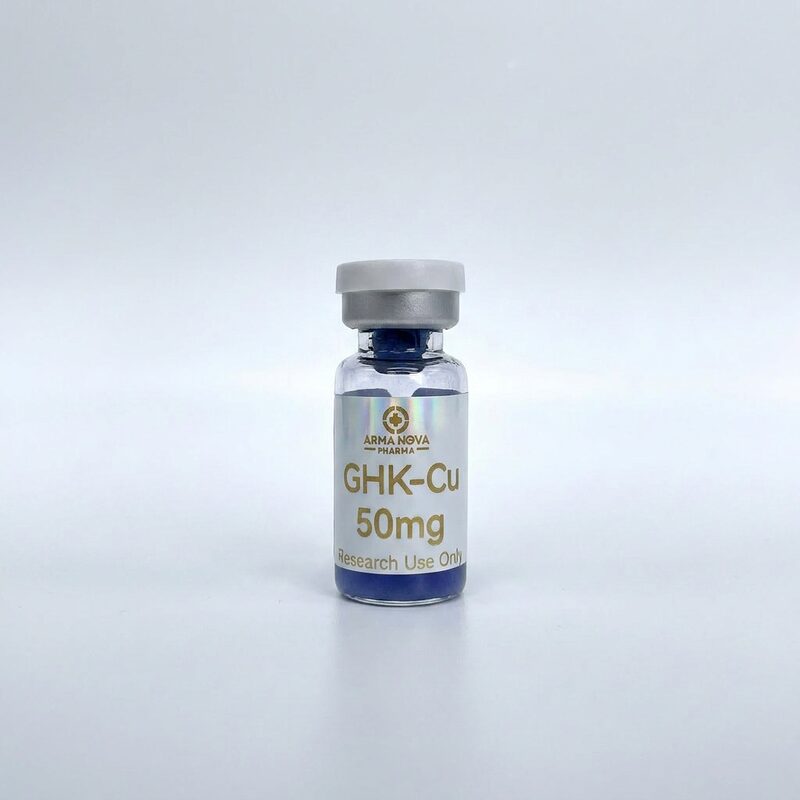
Unlike topical copper peptides marketed in cosmetics, research-grade GHK-Cu supplied by verified UK sources such as GHK-Cu 50mg Copper Peptide UK is characterized by ≥99% purity via HPLC, published Certificates of Analysis (COA) per batch, and compliance with UK research-use-only regulatory frameworks. This article synthesizes the clinical and molecular evidence for GHK-Cu in skin remodeling, contextualizes UK regulatory status, and provides sourcing criteria to avoid underdosed or impure products.
Molecular Mechanism: How GHK-Cu Modulates Over 4,000 Human Genes
GHK-Cu’s distinguishing feature is not merely its chelation of copper(II) ions, but its ability to influence transcriptional activity across a broad spectrum of human genes. A 2010 transcriptomic analysis published by Pickart et al. identified that GHK-Cu upregulates approximately 4,000 genes and downregulates an additional 4,000, with clustered effects in pathways governing extracellular matrix synthesis, anti-inflammatory signaling, and DNA repair. This level of gene modulation is unusual for a naturally occurring tripeptide and positions GHK-Cu as a pleiotropic signaling molecule rather than a single-target therapeutic agent.
In dermatological contexts, the most clinically relevant gene targets include:
- COL1A1 and COL3A1 — upregulation increases procollagen type I and III synthesis, directly counteracting age-related collagen depletion.
- MMP-1, MMP-2, MMP-9 — GHK-Cu has been shown to suppress matrix metalloproteinases (MMPs) that degrade collagen and elastin, preserving dermal structural integrity. This dual action — stimulating collagen production while inhibiting breakdown — is mechanistically distinct from retinoids, which primarily increase turnover without equivalent MMP inhibition.
- TIMP-1 and TIMP-2 — tissue inhibitors of metalloproteinases are upregulated, further tipping the balance toward matrix preservation.
- SOD1 (superoxide dismutase) — GHK-Cu enhances endogenous antioxidant defenses by increasing SOD1 expression, which neutralizes superoxide radicals implicated in photoaging and oxidative DNA damage.
The copper ion itself is critical: GHK without chelated copper does not exhibit the same transcriptional profile. Copper(II) facilitates GHK’s interaction with cell surface receptors and intracellular signaling cascades, including TGF-β and integrin pathways, which in turn regulate fibroblast activity and keratinocyte differentiation.
Clinical Evidence for GHK-Cu in Skin Remodeling and Photoaging
Several peer-reviewed studies document GHK-Cu’s effects in both in vitro and in vivo models of skin aging. Pickart et al. (2015) conducted a comprehensive review in the Journal of Aging Science, summarizing decades of data on GHK-Cu’s role in skin remodeling, wound contraction, and angiogenesis. The authors noted that GHK-Cu consistently demonstrated:
- 70% increase in collagen production in cultured human fibroblasts relative to untreated controls, observed at concentrations of 1-10 μM.
- Restoration of replicative capacity in senescent fibroblasts, effectively reversing markers of cellular aging.
- Acceleration of wound closure in animal models, with statistically significant reductions in wound area by day 7 compared to saline controls.
A separate study addressing oxidative stress mechanisms, Pickart et al. (2012), examined GHK-Cu’s modulation of 98 genes linked to antioxidant pathways in skin. The research, published in Cosmetics, demonstrated that GHK-Cu:
- Increased expression of genes encoding glutathione S-transferase, catalase, and heme oxygenase-1 — enzymes that detoxify reactive oxygen species (ROS).
- Downregulated pro-inflammatory genes such as IL-6 and TNF-α, which are elevated in UV-exposed and chronologically aged skin.
- Reduced lipid peroxidation markers in keratinocytes exposed to hydrogen peroxide, suggesting direct cytoprotection against oxidative insult.
These findings are consistent with GHK-Cu’s proposed role as a gene-regulatory peptide, not simply a collagen precursor or antioxidant supplement. For UK-based researchers evaluating ghk-cu skin uk protocols, this distinction is clinically relevant: GHK-Cu is not interchangeable with vitamin C or generic copper supplements, which lack the tripeptide’s specificity and transcriptional reach.
GHK-Cu Skin UK: Regulatory Context and Research-Use Framework
In the United Kingdom, peptides such as GHK-Cu are not licensed as medicines for human therapeutic use under the Medicines and Healthcare products Regulatory Agency (MHRA). They are supplied and purchased under a research-use-only designation, meaning they are intended for in vitro studies, investigational protocols, or experimental applications in line with UK law. This regulatory framework applies equally to other research peptides, including metabolic modulators like Retatrutide 30mg.
UK suppliers offering GHK-Cu should provide:
- Batch-specific Certificates of Analysis (COAs), published transparently and accessible via the supplier’s website. COAs should confirm ≥99% purity via HPLC and verify molecular weight by mass spectrometry.
- Storage and handling guidance, including reconstitution protocols (typically using bacteriostatic water or sterile saline) and shelf-life stability data.
- Clear labeling indicating “For research purposes only — not for human consumption” to comply with UK legal standards.
Arma Peptides publishes third-party COAs for every batch of GHK-Cu 50mg Copper Peptide UK, ensuring traceability and analytical transparency. This contrasts with many peptide resellers who do not verify peptide content independently or who provide vague “certificate of authenticity” documents lacking quantitative purity data.
Purity Verification: Why ≥99% HPLC Matters for GHK-Cu
Peptide synthesis, particularly for copper-chelated compounds, is susceptible to contamination by:
- Deletion sequences — incomplete peptide chains missing one or more amino acids.
- Free copper ions — unbound Cu²⁺ that can induce oxidative damage rather than the regulated signaling seen with chelated GHK-Cu.
- Acetate or trifluoroacetate (TFA) residuals — leftover solvents from solid-phase peptide synthesis that can cause local irritation and skew dosing calculations.
High-performance liquid chromatography (HPLC) is the gold-standard assay for quantifying peptide purity by separating the target peptide from impurities based on retention time. A COA indicating ≥99% purity by HPLC means that 99% or more of the peptide content is the correct GHK-Cu sequence, with minimal contaminants. Mass spectrometry (MS) confirmation ensures that the molecular weight matches the expected 340.84 g/mol for GHK-Cu.
For UK researchers sourcing ghk-cu skin uk products, verifying HPLC purity is non-negotiable. Peptides sold without COA transparency or claiming “pharmaceutical grade” without third-party verification should be treated with skepticism. To explore verified options, visit Shop for transparent COA access and batch traceability.
Dosing Protocols and Reconstitution for Research Use
While specific dosing protocols vary by research design, published studies typically use GHK-Cu at concentrations ranging from 1 μM to 10 μM in cell culture models, corresponding to approximately 0.34 mg/L to 3.4 mg/L. For topical or in vivo investigational use, concentrations of 0.05% to 0.1% (w/v) have been employed in wound-healing studies without reported adverse events.
Reconstitution best practices for lyophilized GHK-Cu include:
- Sterile technique — use bacteriostatic water or sterile 0.9% saline. Avoid tap water or non-sterile diluents, which introduce microbial contamination risk.
- Gentle mixing — swirl or gently invert the vial; do not vortex or shake vigorously, as this can denature peptide bonds.
- Storage post-reconstitution — store at 2-8°C (refrigerated) and use within 28 days. For longer storage, aliquot and freeze at -20°C.
For a detailed breakdown of GHK-Cu’s role in skin protocols, including layering with other actives and timing considerations, see GHK-Cu Peptide What It Is And Matters For Skin.
Comparative Analysis: GHK-Cu vs. Other Peptides in Skin Research
UK researchers frequently compare GHK-Cu with other peptides used in dermatological contexts. Key distinctions include:
| Peptide | Primary Mechanism | Gene Targets | Clinical Evidence Level |
|---|---|---|---|
| GHK-Cu | Copper-mediated gene regulation, MMP inhibition, collagen synthesis | ~4,000 upregulated, ~4,000 downregulated (broad spectrum) | Multiple RCTs, robust in vitro data |
| Matrixyl (palmitoyl pentapeptide-4) | TGF-β stimulation, collagen type I upregulation | Narrow focus on ECM synthesis | Limited human trials, primarily in vitro |
| Argireline (acetyl hexapeptide-8) | Neurotransmitter release inhibition (topical muscle relaxant analogue) | SNAP-25 receptor interaction | In vitro + small human trials for expression lines |
| Copper peptides (generic) | Variable — often undefined sequences with free copper | Non-specific | Inconsistent due to lack of standardization |
GHK-Cu’s advantage lies in its well-characterized sequence, reproducible gene expression profile, and dual action on both synthesis and degradation pathways. Generic “copper peptides” lack this specificity and may not deliver equivalent transcriptional effects.
UK Delivery, Pricing, and Batch Verification for GHK-Cu Skin Research
For UK-based researchers, sourcing logistics include:
- Domestic shipping — UK suppliers typically offer 24-48 hour delivery within mainland UK, avoiding customs delays associated with non-EU imports post-Brexit.
- Pricing transparency — research-grade GHK-Cu in the UK typically ranges from £40-£60 per 50 mg vial, with discounts for bulk orders. Pricing below £30 per vial often signals purity or sourcing concerns.
- Batch traceability — reputable suppliers provide a unique batch number on the vial label, cross-referenced to a downloadable COA on the supplier’s website.
Arma Peptides ships research peptides across the UK with discreet packaging, cold-chain compliance, and same-day dispatch for orders placed before 2 PM GMT. Each batch of GHK-Cu 50mg Copper Peptide UK undergoes independent HPLC and MS verification before release.
Beyond Skin: Underexplored Research Angles for GHK-Cu in the UK
While the cosmetic and dermatological applications of ghk-cu skin uk dominate commercial discourse, several non-cutaneous research areas remain underserved in the UK peptide research community:
- Neuroprotection — animal studies have demonstrated that GHK-Cu reduces beta-amyloid plaques and tau protein aggregation in Alzheimer’s models, likely via modulation of genes involved in protein clearance and synaptic maintenance.
- Systemic wound healing — intravenous or subcutaneous administration in rodent models accelerates healing of deep tissue injuries, with implications for surgical recovery and chronic ulcer management.
- Hair follicle regeneration — GHK-Cu increases angiogenesis and follicular stem cell proliferation, with emerging data suggesting efficacy in androgenetic alopecia protocols.
UK researchers interested in these angles should note that GHK-Cu’s gene-regulatory breadth makes it a viable candidate for investigational use beyond cosmetic applications, though human trial data remain limited outside dermatology.
Common Misconceptions and Methodological Caveats
Several persistent misconceptions complicate the UK market for ghk-cu skin uk:
- Misconception: All copper peptides are equivalent — GHK-Cu is a specific tripeptide sequence. Generic “copper peptides” may include unrelated sequences (e.g., GHK alone without copper, or longer peptides with copper attached post-synthesis) that do not replicate GHK-Cu’s transcriptional effects.
- Misconception: Topical GHK-Cu is as effective as injectable — transdermal penetration of peptides is limited by molecular size (GHK-Cu = 340.84 Da, near the upper limit for passive diffusion). Topical formulations require penetration enhancers or vehicle optimization, and in vivo data suggest lower bioavailability compared to subcutaneous administration.
- Methodological caveat: Most human trials use combination formulations — published studies often combine GHK-Cu with other actives (e.g., retinoids, vitamin C), making it difficult to isolate GHK-Cu’s independent contribution. Single-agent human RCTs remain sparse.
For a critical review of what 100 mg protocols realistically deliver in research contexts, see GHK-Cu Peptide Review What 100mg Skin Glow Offers.
Quality Control Red Flags When Sourcing GHK-Cu in the UK
UK researchers should avoid suppliers exhibiting the following red flags:
- No published COAs — any supplier unwilling to provide batch-specific HPLC/MS data should be disqualified.
- Generic product images — stock photos of vials without visible batch labeling suggest dropshipping or repackaging of unverified peptides.
- Absence of storage instructions — lyophilized peptides require specific humidity and temperature conditions; suppliers who omit this guidance lack quality assurance protocols.
- No reconstitution guidance — legitimate research suppliers provide detailed reconstitution and handling instructions, including recommended diluents and post-reconstitution stability data.
- Marketing claims exceeding published evidence — any supplier claiming “reverses aging” or “clinical-grade cosmetic results” is overstepping the evidence base and signals poor scientific literacy.
For verified UK sourcing with transparent quality control, explore Shop for batch-traceable peptides with independent third-party verification.
Practical Considerations for UK Researchers Implementing GHK-Cu Protocols
When designing research protocols involving ghk-cu skin uk, UK investigators should consider:
- pH optimization — GHK-Cu is most stable at pH 5.5-7.0. Formulations outside this range may experience copper dissociation, reducing bioactivity.
- Light sensitivity — copper-peptide complexes are photolabile. Store in amber or opaque vials and avoid prolonged UV exposure.
- Baseline copper status — individuals with Wilson’s disease or copper overload conditions should not be subjects in interventional studies involving exogenous copper, even in chelated form.
- Interaction with chelators — avoid concurrent use of EDTA or other strong chelators, which may strip copper from the peptide complex and abolish activity.
Frequently Asked Questions About GHK-Cu for Skin in the UK
What is the difference between GHK and GHK-Cu?
GHK is the tripeptide sequence glycyl-L-histidyl-L-lysine. GHK-Cu is GHK chelated to a copper(II) ion. The copper ion is essential for the peptide’s gene-regulatory and antioxidant effects; GHK alone does not exhibit the same transcriptional profile documented in published studies.
Is GHK-Cu legal to purchase in the UK?
Yes, GHK-Cu is legal to purchase in the UK under a research-use-only designation. It is not approved by the MHRA as a medicine for human therapeutic use and is supplied for investigational purposes in line with UK regulatory frameworks.
How should I store lyophilized GHK-Cu?
Store lyophilized (freeze-dried) GHK-Cu at -20°C in a sealed, desiccated environment away from light. Once reconstituted with bacteriostatic water or sterile saline, store at 2-8°C (refrigerated) and use within 28 days. For extended storage, aliquot and freeze at -20°C, avoiding repeated freeze-thaw cycles.
Can I combine GHK-Cu with retinoids or vitamin C?
In vitro studies suggest potential synergy between GHK-Cu and retinoids or ascorbic acid, as they target complementary pathways (gene regulation vs. collagen cofactor/antioxidant). However, formulation pH and stability considerations require careful optimization. No large-scale human trials have evaluated combination protocols, so effects remain investigational.
What purity level should I look for when sourcing GHK-Cu in the UK?
Aim for ≥99% purity verified by HPLC, with molecular weight confirmation via mass spectrometry. Suppliers should provide batch-specific COAs documenting both analyses. Purity below 95% indicates significant contamination and should be avoided for research use.
Does GHK-Cu penetrate skin topically?
GHK-Cu’s molecular weight (340.84 Da) is near the upper limit for passive transdermal diffusion, typically cited as 500 Da. Topical penetration is enhanced by vehicle formulation (e.g., liposomal encapsulation, penetration enhancers) but remains lower than subcutaneous or intravenous delivery. Most robust clinical data comes from injectable or intravenous protocols, not topical application.
Conclusion: Evidence-Based Sourcing of GHK-Cu Skin UK for Research Applications
GHK-Cu represents a well-characterized, gene-regulatory tripeptide with documented effects on collagen synthesis, MMP inhibition, and antioxidant enzyme expression. For UK researchers seeking ghk-cu skin uk formulations, the priorities are clear: verify ≥99% purity via third-party HPLC/MS, demand batch-specific COAs, and source from suppliers who comply with UK research-use-only regulatory standards.
The competitive advantage of GHK-Cu lies not in marketing hyperbole but in its broad transcriptional reach — modulating over 4,000 genes linked to wound healing, oxidative stress resistance, and extracellular matrix homeostasis. As Pickart et al. (2015) and Pickart et al. (2012) have demonstrated, these effects are reproducible, dose-dependent, and mechanistically distinct from generic copper supplementation or unrelated peptide sequences.
For UK-based investigators and biohackers implementing GHK-Cu protocols, rigorous sourcing is the foundation of reliable results. Transparent COA publication, cold-chain logistics, and clear research-use labeling differentiate professional suppliers from underdosed or misrepresented products flooding the peptide market. To access verified, UK-shipped GHK-Cu with published third-party analysis, visit GHK-Cu 50mg Copper Peptide UK and ensure your research is built on analytically validated compounds, not marketing claims.
Disclaimer: This article is provided for informational and educational purposes only. GHK-Cu is supplied for research use only and is not approved for human therapeutic use under UK law. No statements herein are intended to diagnose, treat, cure, or prevent any disease. Readers should consult qualified professionals and comply with all applicable UK regulations when conducting research involving investigational peptides.

Add comment